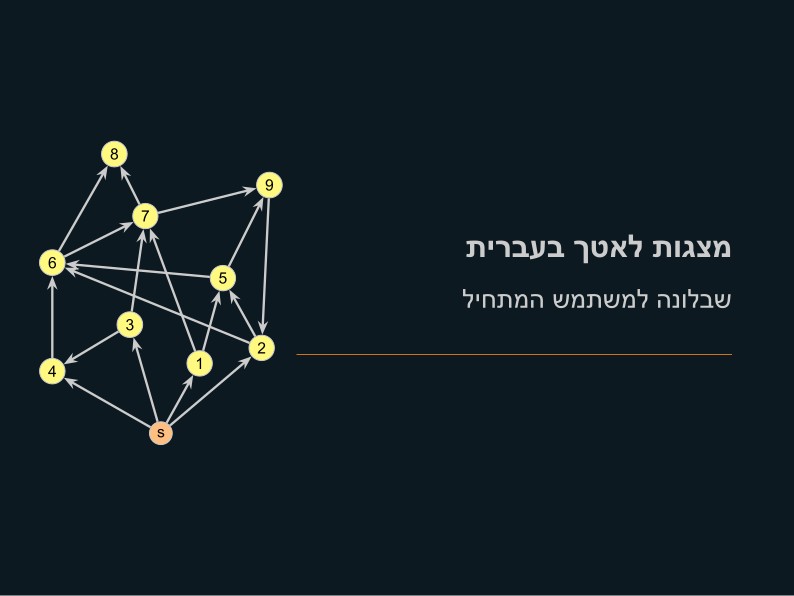
Hebrew Latex Beamer
Author:
Yuval Itzhaki
Last Updated:
před měsícem
License:
Creative Commons CC BY 4.0
Abstract:
Hebrew Latex Beamer presentations.
\begin
Discover why over 25 million people worldwide trust Overleaf with their work.
\begin
Discover why over 25 million people worldwide trust Overleaf with their work.
%! TEX program = lualatex
\RequirePackage{luatex85}
\PassOptionsToPackage{luatex}{hyperref}
\documentclass[luatex]{beamer}
%%%%%%%%%%
% BEAMER %
%%%%%%%%%%
\usepackage{xcolor,amssymb}
\usetheme{metropolis}
\definecolor{mytextcolor}{rgb}{0.,0.,0.}
\definecolor{mybackgroundcolor}{rgb}{1,1,1} \definecolor{mysolutioncolor}{rgb}{1,0,0}
\definecolor{mysecondsolutioncolor}{rgb}{0,0,1} % blue
\definecolor{myblue}{rgb}{0,0,1} % blue
\definecolor{myred}{rgb}{1,0,0} % red
\definecolor{mygreen}{rgb}{0,1,0} % green
% % % UNCOMMENT TO TURN ON DARK MODE
\definecolor{mybackgroundcolor}{rgb}{0.05,0.1,0.125} % Dark blue/black
\definecolor{mytextcolor}{rgb}{0.8,0.8,0.8} % Grey
\definecolor{mysolutioncolor}{rgb}{1,1,0} % yellow
\definecolor{mysecondsolutioncolor}{rgb}{1,.5,.4} % orange
\definecolor{myblue}{rgb}{.56,.84,1} % blue
\definecolor{myred}{rgb}{1,.28,.3} % red
\definecolor{mygreen}{rgb}{0,1,0} % green
\setbeamercolor{background canvas}{bg=mybackgroundcolor}
\setbeamercolor{section title}{fg=white,bg=red!50!black}
\setbeamercolor{normal text}{fg=mytextcolor}
\definecolor{mPurple}{RGB}{91,48,105}
\setbeamercolor{palette primary}{bg=mybackgroundcolor}
% % % END OF DARKMODE CODE BLOCK
\usepackage{multicol}
\usepackage{emoji}
\usepackage{graphicx}
\usepackage{amsthm}
\usepackage{ pgffor }
\usepackage{tikz}
\usepackage{tikz-network}
\usetikzlibrary{arrows.meta}
\usepackage{subcaption}
\usetikzlibrary{trees}
\usetikzlibrary{overlay-beamer-styles}
\usetikzlibrary{positioning,chains,fit,shapes,calc}
\usepackage{pgfplots}
\pgfplotsset{compat=1.18}
\usepackage{catchfilebetweentags}
% good af for maths
\usepackage{amsmath}
% Change bullet types in itemize
\usepackage{enumitem}
\usepackage{pifont}
% Headers
\usepackage{fancyhdr}
\pagestyle{fancy}
% Table
\usepackage{amsfonts}
\usepackage{booktabs}
\usepackage{siunitx}
% highlight
\usepackage{color,soul}
\usepackage{transparent}
% Lightning Symbol
\usepackage{mathtools}
\usepackage{marvosym}
% substrings and document name parser
\usepackage[realmainfile]{currfile}
\usepackage{stringstrings}
\newcommand{\documentNumber}[0]{\substring{\currfilebase}{3}{4}\par}
% change background theme according to manual
% \metroset{background=dark}
% \usebeamercolor[fg]{normal text}
% Fix the title separator
\makeatletter
\setbeamertemplate{title separator}{
\bgroup
\bodydir TLT
\begin{tikzpicture}
\fill[fg] (0,0) rectangle (\textwidth, \metropolis@titleseparator@linewidth);
\end{tikzpicture}%
\egroup
\par%
}
\makeatother
\addtobeamertemplate{frametitle}{}{%
\begin{tikzpicture}[remember picture,overlay]
% \coordinate (logo) at ([xshift=-0.5cm,yshift=-2.8cm]current page.north west);
% \fill[devryblue] (logo) circle (.9cm);
% % \clip (logo) circle (.75cm);
\node at (.85\paperwidth,.7) {
\includegraphics[width=.9cm]{logo.png}};
% \node at (.75\paperwidth,.7) {\includegraphics[width=3.75cm]{administration/bgu-logo-negative.png}};
\end{tikzpicture}}
% Fix the progress bar and make it progress from right to left
\makeatletter
\setbeamertemplate{progress bar in section page}{
\setlength{\metropolis@progressonsectionpage}{%
\textwidth * \ratio{\insertframenumber pt}{\inserttotalframenumber pt}%
}%
\bgroup
\bodydir TLT
\begin{tikzpicture}
\fill[bg] (0,0) rectangle (\textwidth, \metropolis@progressonsectionpage@linewidth);
\fill[fg] (\textwidth,0) rectangle (\textwidth-\metropolis@progressonsectionpage, \metropolis@progressonsectionpage@linewidth);
\end{tikzpicture}%
\egroup
}
\makeatother
% A more logical title page, juxtaposing `institute` to `author`. This modification is not necessary for Hebrew support.
\makeatletter
\setbeamertemplate{title page}{
\begin{minipage}[b][\paperheight]{.65\textwidth}
\ifx\inserttitlegraphic\@empty\else\usebeamertemplate*{title graphic}\fi
\vfill%
\ifx\inserttitle\@empty\else\usebeamertemplate*{title}\fi
\ifx\insertsubtitle\@empty\else\usebeamertemplate*{subtitle}\fi
\usebeamertemplate*{title separator}
\ifx\beamer@shortauthor\@empty\else\usebeamertemplate*{author}\fi
\ifx\insertinstitute\@empty\else\usebeamertemplate*{institute}\fi
\ifx\insertdate\@empty\else\usebeamertemplate*{date}\fi
\vfill
\vspace*{1mm}
\end{minipage}~
\ifx\inserttitlegraphic\@empty\else\inserttitlegraphic\fi
}
\setbeamertemplate{author}{\vspace*{2em}\insertauthor\par\vspace*{0.25em}}
\setbeamertemplate{institute}{\insertinstitute\par}
\setbeamertemplate{date}{\vspace*{3mm}\insertdate\par}
\makeatother
%%%%%%%%%
% Babel %
%%%%%%%%%
% \usepackage[bidi=basic, hebrew, provide=*]{babel}
\usepackage[nil,bidi=basic-r]{babel}
\babelprovide[import=he,main]{hebrew}
\babelprovide[import=en-GB]{english}
% \babelprovide[import=cy]{welsh}
\babelprovide[Alph=letters]{hebrew}
\babelprovide[alph=letters]{hebrew}
% For some reason Babel’s `\babelfont` doesn’t work
% \setsansfont[Script=Hebrew]{Miriam Mono CLM}
% \setmonofont{Miriam Mono CLM}
\setsansfont[Script=Hebrew]{Arial}
\setmonofont{Arial}
\renewcommand{\H}[1]{\foreignlanguage{hebrew}{\fontspec[Script=Hebrew]{Miriam Mono CLM}#1}}
\newcommand{\nikud}[1]{$\mbox{\H{#1}}$}
\newcommand{\E}[1]{\foreignlanguage{english}{\fontspec{Open Sans}#1}}
\newcommand{\C}[1]{\foreignlanguage{welsh}{\fontspec{Open Sans}#1}}
\newcommand{\LR}[1]{{\textdir TLT #1}}
\newcommand{\bigO}{\mathcal{O}}
% \newcommand{\NP}{\textenglish{\textnormal{\textsf{NP}}}}
% \newcommand{\PP}{\textenglish{\textnormal{\textsf{P}}}}
\newcommand{\NP}{NP}
\newcommand{\PP}{P}
%%%%%%%%
% MISC %
%%%%%%%%
\usepackage{metalogo, fancyvrb}
\newcommand{\smallurl}[1]{{\footnotesize\url{#1}}}
% Switch implementation
\usepackage{xifthen}
\newcommand{\ifequals}[3]{\ifthenelse{\equal{#1}{#2}}{#3}{}}
\newcommand{\case}[2]{#1 #2}
\usepackage{ifthen}
\usepackage{hyperref}
\usepackage{algorithm}
\usepackage[noend]{algpseudocode}
% \usepackage{algorithm2e}
% \usepackage{algorithmic}
% \usepackage[linesnumbered,ruled,vlined]{algorithm2e}
\usepackage{tabularx,booktabs,multirow} % all about tables: booktabs gives the standard formatting, multirow allows cells to span over multiple rows.
\newcommand{\problemdef}[3]{
\begin{minipage}{1\textwidth}
% \fontspec{Miriam Mono CLM}
% \textsc{#1}
\hspace{1.cm}
\noindent
\textbf{#1}
\vspace{2pt}
\setlength{\tabcolsep}{3pt}
\begin{tabularx}{1\textwidth}{lr}
#2 & \textbf{קלט:}\\
#3 & \textbf{שאלה:} \end{tabularx}
\end{minipage}
}
%%%%%%%%%%%%
% DOCUMENT %
%%%%%%%%%%%%
\begin{document}
\newenvironment{switch}[1]{\renewcommand{\case}{\ifequals{#1}}}{}
% Example: Pick color by ID
\newcommand{\incolor}[2]{
\begin{switch}{#1}
\case{1}{A}
\case{2}{}
#2
\end{switch}
}
\renewcommand{\thefootnote}{\alph{footnote}}
\title{מצגות לאטך בעברית}
\subtitle{שבלונה למשתמש המתחיל}
% \author{}
\date{}
\titlegraphic{
\selectlanguage{english}
\vspace{1.5cm}
\begin{figure}[H]
\hspace*{-11.5cm}
\scalebox{.5}{
\begin{tikzpicture}
\begin{scope}[every node/.style={circle,thick,draw,text=black,fill=yellow!50,minimum size =.7cm}]
\node[fill=orange!50] (s) at (-.5,-1) {\Large s};
\node[fill=yellow!50] (2) at (2.75,1.75) {\Large 2};
\node[fill=yellow!50] (1) at (.75,1.25) {\Large 1};
\node[fill=yellow!50] (3) at (-1.5,2.5) {\Large 3};
\node[fill=yellow!50] (4) at (-4,1) {\Large 4};
\node[fill=yellow!50] (6) at (-4,4.5) {\Large 6};
\node[fill=yellow!50] (7) at (-1,6) {\Large 7};
\node[fill=yellow!50] (5) at (1.5,4) {\Large 5};
\node[fill=yellow!50] (8) at (-2,8) {\Large 8};
\node[fill=yellow!50] (9) at (3,7) {\Large 9};
\end{scope}
% [bend left=40]
\begin{scope}[>={Stealth[mytextcolor]},
every node/.style={},
% every node/.style={fill=white,circle},
% every edge/.style={draw=myblue,very thick}
% every edge/.style={}
]
\onslide<1>{
\path [->,draw=mytextcolor,line width = .75mm] (s) edge node {} (1);
\path [->,draw=mytextcolor,line width = .75mm] (s) edge node {} (2);
\path [->,draw=mytextcolor,line width = .75mm] (s) edge node {} (3);
\path [->,draw=mytextcolor,line width = .75mm] (s) edge node {} (4);
\path [->,draw=mytextcolor,line width = .75mm] (1) edge node {} (5);
\path [->,draw=mytextcolor,line width = .75mm] (1) edge node {} (7);
\path [->,draw=mytextcolor,line width = .75mm] (2) edge node {} (5);
\path [->,draw=mytextcolor,line width = .75mm] (2) edge node {} (6);
\path [->,draw=mytextcolor,line width = .75mm] (3) edge node {} (4);
\path [->,draw=mytextcolor,line width = .75mm] (3) edge node {} (7);
\path [->,draw=mytextcolor,line width = .75mm] (4) edge node {} (6);
\path [->,draw=mytextcolor,line width = .75mm] (6) edge node {} (7);
\path [->,draw=mytextcolor,line width = .75mm] (6) edge node {} (8);
\path [->,draw=mytextcolor,line width = .75mm] (7) edge node {} (8);
\path [->,draw=mytextcolor,line width = .75mm] (7) edge node {} (9);
\path [->,draw=mytextcolor,line width = .75mm] (5) edge node {} (6);
\path [->,draw=mytextcolor,line width = .75mm] (5) edge node {} (9);
\path [->,draw=mytextcolor,line width = .75mm] (9) edge node {} (2);
}
\onslide<2>{
\path [->,>={Stealth[myblue]},draw=myblue, ultra thick] (s) edge node {} (1);
\path [->,>={Stealth[gray!50]},draw=gray!50,line width = .75mm] (s) edge node {} (2);
\path [->,>={Stealth[myblue]},draw=myblue, line width = 1mm] (s) edge node {} (3);
\path [->,>={Stealth[gray!50]},draw=gray!50,line width = .75mm] (s) edge node {} (4);
\path [->,>={Stealth[myblue]},draw=myblue, line width = 1mm] (1) edge node {} (5);
\path [->,>={Stealth[gray!50]},draw=gray!50,line width = .75mm] (1) edge node {} (7);
\path [->,>={Stealth[gray!50]},draw=gray!50,line width = .75mm] (2) edge node {} (5);
\path [->,>={Stealth[gray!50]},draw=gray!50,line width = .75mm] (2) edge node {} (6);
\path [->,>={Stealth[myblue]},draw=myblue, line width = 1mm] (3) edge node {} (4);
\path [->,>={Stealth[gray!50]},draw=gray!50,line width = .75mm] (3) edge node {} (7);
\path [->,>={Stealth[myblue]},draw=myblue, line width = 1mm] (4) edge node {} (6);
\path [->,>={Stealth[myblue]},draw=myblue, line width = 1mm] (6) edge node {} (7);
\path [->,>={Stealth[gray!50]},draw=gray!50,line width = .75mm] (6) edge node {} (8);
\path [->,>={Stealth[myblue]},draw=myblue, line width = 1mm] (7) edge node {} (8);
\path [->,>={Stealth[myblue]},draw=myblue, line width = 1mm] (7) edge node {} (9);
\path [->,>={Stealth[gray!50]},draw=gray!50,line width = .75mm] (5) edge node {} (6);
\path [->,>={Stealth[gray!50]},draw=gray!50,line width = .75mm] (5) edge node {} (9);
\path [->,>={Stealth[myblue]},draw=myblue, line width = 1mm] (9) edge node {} (2);
}
\end{scope}
\end{tikzpicture}
}
\end{figure}
\selectlanguage{hebrew}
}
\frame[plain]{\titlepage}
\begin{frame}[plain,t]{מצגות בלאטך}
אם הגעתם לכאן מהשבלונה ״פרוייקט לאטך בעברית״ ברוכים השבים!
אחרת, אמליץ לכם לבדוק גם אותו
\href{https://www.overleaf.com/latex/templates/hebrew-latex-template/rjkfxyhmmqfm}{\color{mysolutioncolor} \textbf{בקישור הזה}}.
הפרוייקט הזה משתמש במהדר
\text{LuaLaTex}
ולכן הוחלט להפריד אותו מפרוייקט המסמכים הרגיל שמשתמש במהדר
\text{XeLaTex}.
כן, זה לא מושלם אבל כאלה החיים.
מקווה שאפתור את הבעיה הזו בקרוב.
עד אז אני מקווה שהשבלונה הזאת תעזור למתחילים.
\pause
\vspace{.5cm}
{\Huge \color{mysolutioncolor}
מצגות צריכות להיות כהות!}
\pause
{
אבל למקרה שאתם צריכים גרסא מתאימה להדפסה
תשתמשו בקובץ
\text{EX00.tex}
או שתמחקו את הקוד בין
\text{UNCOMMENT TO TURN ON DARK MODE}
ל
\text{END OF DARKMODE CODE BLOCK}.
}
\end{frame}
\begin{frame}[plain,t]{ מה אפשר לעשות?}
מומלץ להשתמש בהנפשות
\onslide<2->{
\begin{enumerate}[label = \arabic*.]
\item \alt<2>{\textbf{כדי לחשוף טקסט}}{\color{gray} \textbf{כדי לחשוף טקסט}\color{mytextcolor}}
\item \alt<3>{\textbf{שורה אחר שורה}}{\color{gray} \textbf{שורה אחר שורה}\color{mytextcolor}}
\item \alt<4>{ \textbf{וכדי להדגיש את מה שמעניין באותו רגע
}}{\color{gray}\textbf{\textbf{וכדי להדגיש את מה שמעניין באותו רגע
}}
\color{mytextcolor}}
\end{enumerate}
}
\onslide<2->{
טקסט \alt<4>{\textbf{כמו}}{כמו} זה.
}
\onslide<3->{
או משוואות כמו זו:
\begin{align*}
\frac{\partial \mathbf{u}}{\partial t} + (\mathbf{u} \cdot \nabla) \mathbf{u} &= -\nabla p + \nu \nabla^2 \mathbf{u} + \mathbf{f}
\end{align*}
}
\onslide<4->{
כמו שפתאום המילה ״כמו״ למעלה מודגשת.
}
\only<5>{
\selectlanguage{english}
\begin{tikzpicture}[overlay]
\pgftransformshift{\pgfpointanchor{current page}{center}}
\node (img2) at (-1.,-1.0)
{
\begin{tikzpicture}[background rectangle/.style={fill=yellow!20, draw=mytextcolor, line width =.15cm}, show background rectangle]
\begin{axis}[
scale=.7,
ybar interval,
xmajorgrids=false,
ticks=none,
yticklabels={,,},
xticklabels={,,},
axis lines=middle,
enlargelimits,
xlabel={\color{black}$m$},
xmax=10*.9,ymax=55,
axis line style = {black},
% xlabel near ticks,
% x label style={at={(1.2,-.2)}},
y label style={
% rotate=90,
at={(-.05,.95)}},
ylabel={\color{black}$y$},
]
\addplot[fill=orange] plot coordinates
{(0,15) (1*.8,50) (2*.8,30) (3*.8,20) (4*.8,40) (5*.8,10)
(6*.8,30) (7*.8,20) (8*.8,40) (9*.8,30)};
\addplot[smooth,ultra thick, dashed, red] plot coordinates {
(0,50)
(9.25*.8,50)
};
\node[] at (250,450) {\color{red}$\bigO(\max\limits_i f_i(n))$};
\end{axis}
\node at (6,4) {\color{black}
\textbf{ניתוח נאיבי}
};
\node at (6,3) {\color{black}
$m \cdot \bigO(\max\limits_i f_i(n))$
};
\node at (6,2) {\color{black}
\textbf{ניתוח גלובלי }
};
\node at (6,1) {\color{black}
$\sum\limits_{i\leq m} f_i(n)$
};
\node at (7,1) {};
\node at (3.5,5) {\color{black}
\textbf{אפשר גם ליצור חלון קופצים}
};
\end{tikzpicture}
};
\end{tikzpicture}
}
\selectlanguage{hebrew}
\end{frame}
\begin{frame}[plain,t]{סימולציה של אלגוריתם}
\begin{columns}
\begin{column}{0.5\textwidth}
\selectlanguage{english}
\begin{tikzpicture}
[
scale = 0.4,
level 1/.style ={sibling distance=5.5cm, level distance=3cm},
level 2/.style ={sibling distance=6cm},
level 3/.style ={sibling distance=4cm},
every node/.style = {
text=black,
circle,thick,draw
},
every path/.style = {
line width=.75mm,
mytextcolor
}
]
\node[fill=red!50, visible on=<2->] (root) {$I$}
child[visible on=<3->] {
node[fill=orange!50] {$A$}
child[visible on=<4->] {
node[fill=orange!25] {$B$}
child[visible on=<6->] {
node[fill=yellow!50] {$E$}
}
child[visible on=<7->] {
node[fill=yellow!50] {$C$}
child[visible on=<9->] {
node[fill=blue!25] {$D$}
child[visible on=<10->] {
node[alt={<10->{fill=blue!50}}] {$H$}
}
}
}
}
child[visible on=<5->] {
node[fill=orange!25] {$F$}
child[visible on=<8->] {
node[fill=yellow!50] {$G$}
}
}
}
;
\begin{scope}[every node/.style={right}]
\onslide<11->{
\node at (4.5,0) {$d=0$};
\node at (4.5,-3) {$d=1$};
\node at (4.5,-6) {$d=2$};
\node at (4.5,-9) {$d=3$};
\node at (4.5,-12) {$d=4$};
\node at (4.5,-15) {$d=5$};
}
\end{scope}
\end{tikzpicture}
\end{column}
\begin{column}{0.5\textwidth}
\selectlanguage{english}
\begin{figure}[T]
\vspace{-1.cm}
\scalebox{0.7}{
\begin{minipage}{1.5\linewidth}
\begin{algorithm}[H]
\caption*{\text{BFS($G=(V,E),v)$}}\label{alg:BFS}
\begin{algorithmic}[1]
% \State Mark all vertices \textit{non-visited}.
\State Create empty list $L$.
\State Add $v$ to the tail of $L$.
\While{$L \neq \varnothing$ }
\State Let $u$ be the head of $L$.
\State Mark $u$ \textit{visited} and remove it from $L$.
\For{$w \in N(u)$}
\If{$w$ is \textit{non-visited} }
\State Add $w$ to the tail of $L$.
\EndIf
\EndFor
\EndWhile
\end{algorithmic}
\end{algorithm}
% \caption{Caption}
\end{minipage}
}
% \label{fig:enter-label}
\end{figure}
\begin{figure}[H]
\centering
\scalebox{0.7}{
\begin{tikzpicture}
\begin{scope}[every node/.style={circle,thick,draw}]
\node[alt={<3->{text=black,fill=orange!50}}] (A) at (2,4) {A};
\node[alt={<4->{text=black,fill=orange!25}}] (B) at (5,4) {B};
\node[alt={<7->{text=black,fill=yellow!50}}] (C) at (6,3) {C};
\node[alt={<9->{text=black,fill=blue!25}}] (D) at (7,2) {D};
\node[alt={<6->{text=black,fill=yellow!50}}] (E) at (4,3) {E};
\node[alt={<5->{text=black,fill=orange!25}}] (F) at (3,1) {F};
\node[alt={<8->{text=black,fill=yellow!50}}] (G) at (5,2) {G};
\node[alt={<10->{text=black,fill=blue!50}}] (H) at (8,3) {H};
\node[alt={<2->{text=black,fill=red!50}}] (I) at (1,2) {I};
\end{scope}
\begin{scope}[>={Stealth[black]},
every node/.style={circle},
every edge/.style={draw=mytextcolor,line width=1mm}]
\path [-] (A) edge[alt={<4->{draw=myblue}}] node {} (B);
\path [-] (A) edge[alt={<3->{draw=myblue}}] node {} (I);
\path [-] (A) edge[alt={<5->{draw=myblue}}] node {} (F);
\path [-] (B) edge[alt={<7->{draw=myblue}}] node {} (C);
\path [-] (B) edge[alt={<6->{draw=myblue}}] node {} (E);
\path [-] (C) edge[alt={<9->{draw=myblue}}] node {} (D);
\path [-] (D) edge[] node {} (G);
\path [-] (D) edge[alt={<10->{draw=myblue}}] node {} (H);
\path [-] (E) edge[] node {} (C);
\path [-] (E) edge[] node {} (G);
\path [-] (G) edge[alt={<8->{draw=myblue}}] node {} (F);
\end{scope}
\end{tikzpicture}
}
% \caption{Caption}
\label{fig:enter-label}
\end{figure}
\end{column}
\end{columns}
\end{frame}
\end{document}